Strawberry
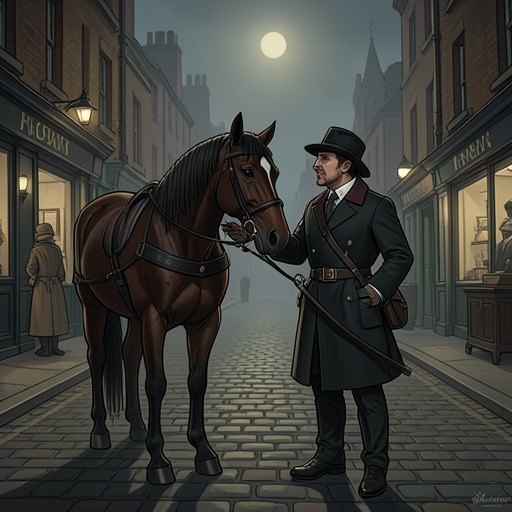
The Magician's NephewStrawberry is the London cab-horse carried into Narnia whose transformation from working animal into a Talking Beast and, finally, the winged horse Fledge makes him a living bridge between the human world and the new creation. His change is not merely physical: when Aslan awakens the creatures, Strawberry can speak and begin to understand his past, and Aslan gives him a new name and a defining place among Narnia’s flying horses.
Identity and Introduction
Strawberry first arrives in the wood with Digory, Polly, the Witch, Uncle Andrew, and the Cabby. The group’s accidental journey has brought the horse with them; when they emerge into the warm green sunshine, Polly notices the unexpected company. Strawberry’s condition immediately distinguishes him from the humans. The Witch bends over him, visibly sickened by the wood, while Strawberry shakes his head, whinnies, and seems to recover. His ears rise from their flattened position and the fire goes out of his eyes. The Cabby recognizes the change and reassures him with a hand on his neck.
Even before he can speak, Strawberry acts according to his own needs. Thirsty, he walks to a nearby pool to drink. Because the others are physically connected to him and one another, his ordinary attempt to get water instead carries the entire party into darkness and another world. The moment makes him an active participant in the chain of events: his thirst is his own, but the human group’s grip turns it into an accidental passage.
Awakening and Memory
When Aslan’s creation awakens the inhabitants of Narnia, Strawberry is among the animals who receive speech and thought. He is the first to speak after the assembled creatures answer Aslan, interrupting the solemn response with an admission that he and the others do not yet know much. The children jump at the sound of the cab-horse’s voice. Polly is glad that Strawberry is one of the animals chosen to become a Talking Beast, while the Cabby responds with pride, recalling that he had always thought the horse sensible.
Strawberry’s new speech gives him a way to describe the strange state of his memory. He suspects that he lived somewhere else, or was something else, before Aslan woke the animals, but says that the recollection is muddled like a dream. He does remember that the people now before him resemble figures from that earlier existence. The Cabby tries to prompt recognition by recounting how he had fed Strawberry warm mash, rubbed him down, and covered him against the cold. Those acts of care matter to their reunion, but Strawberry’s first clear recollection is also of the horse’s labor: he remembers a black vehicle tied behind him and the demand to run while it rattled after him. His awakening restores speech before it restores a complete account of his past.
Labor, Recognition, and Animal Agency
Strawberry’s memories place care and coercion side by side. The Cabby recalls tending to him when he was out of sorts and protecting him from the cold; Strawberry, in turn, recalls pulling a vehicle and being hit to make him run. Neither recollection erases the other. Their exchange gives the former working relationship a voice from both sides, with Strawberry no longer simply an animal the Cabby describes but a participant who can question, remember, and correct the human account of their shared life.
That change in status also exposes how much the newly awakened creatures do not know. Strawberry cannot immediately identify the Cabby, and his memory returns only as he thinks through it. Elsewhere, Uncle Andrew’s attempt to speak to a dog produces only a vague sizzling noise to the animals, who cannot understand him. The contrast is pointed: Strawberry can cross the boundary between horse and human conversation, while Uncle Andrew remains unintelligible to the Talking Beasts. Speech in Narnia is not a decorative gift; it changes who can be heard and recognized, and allows Strawberry to make his own past part of the story.
Fledge and the Quest
After Digory is sent to seek the Silver Apple, Aslan promises him help and turns to Strawberry. The horse is standing quietly nearby, listening with his head tilted as though the conversation is difficult to follow. Aslan asks whether he would like to be a winged horse. Strawberry’s response is visible in the shake of his mane, the widening of his nostrils, and a small tap of one back hoof, although he answers with humility, uncertain why he should be chosen and insisting that he is not clever.
Aslan names and commissions him in a single command: he is to be winged and to become the father of all flying horses. Strawberry shies and rears, then stretches his neck as though trying to reach an irritation at his shoulders. Wings burst out there, growing larger than those of eagles or swans; their feathers shine chestnut and copper. He sweeps them, leaps into the air, circles once above Aslan and Digory, and lands with all four hooves together. His awkward, surprised landing does not diminish his pleasure. The former cab-horse, once made to run with a rattling vehicle behind him, now rises into the air under his own power and is given a future that extends beyond his individual service.
Narrative Significance
Strawberry’s trajectory turns the book’s treatment of animals from objectification toward acknowledged personhood. Earlier, Uncle Andrew explains that he experimented on guinea-pigs, some of whom died and some of whom exploded, treating their lives as instruments in his search for a way to reach other worlds. Strawberry’s experience is different in kind but connected by the question of human power over animals: he has been made to pull a cab, yet in Narnia he speaks about that labor in his own words and receives a role from Aslan that is not defined by human use.
The transformation also joins personal recovery to the founding of a wider community. Aslan gives the creatures the land, its woods, fruit, and rivers, and tells them to treat the Dumb Beasts gently without returning to their ways. Strawberry’s new identity therefore stands within a larger distinction between animal life without speech and a life of thought, language, and responsibility. His memory remains incomplete, but the story does not need it to become complete before he can act: he can answer, recognize fragments of his past, accept a new name, and take flight as Fledge.